
Design · Modern homes
What a modern home means for a London house, from rear extensions on period terraces to open-plan zones and daylight, with AURA projects and what a modern home architect does at each stage.
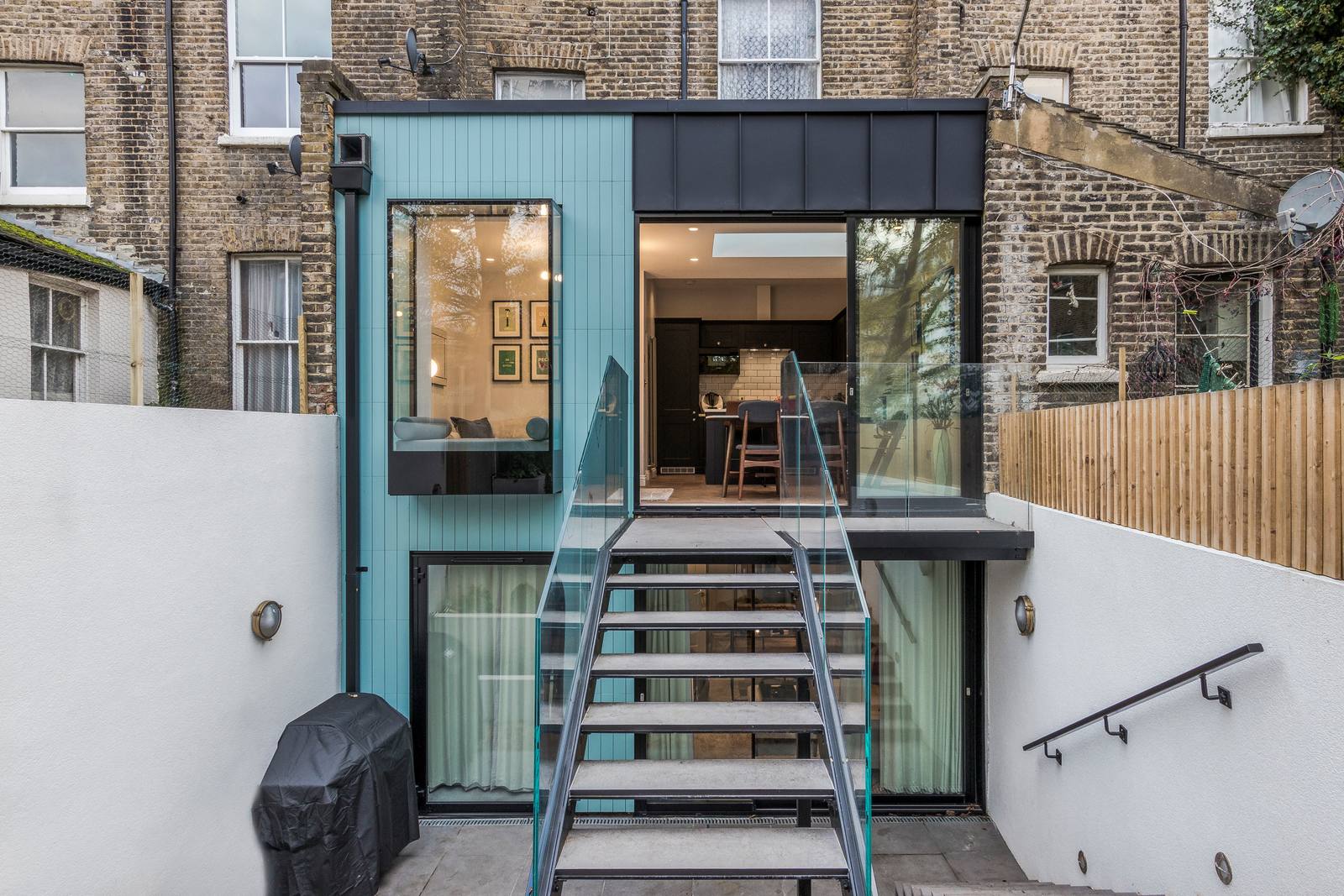
A modern home in London is usually a period house remodelled for the way people live now: a rear or side extension, an open-plan kitchen and living space divided into zones, large steel-framed glazing and rooflights, and better insulation. A modern home architect designs the new parts so they read clearly against the old house and get through planning.
Key takeaways
- In London a modern home usually starts with an existing house, so the design starts with the house and the street, then the new work.
- Open plan works well in zones, each with its own light, joined by sightlines.
- In London the noon sun is 61.9° above the horizon in June and 15.1° in December, so the same glazing behaves very differently through the year.
- Conservation areas don’t rule out modern design, but the planning case has to show how the new work fits the place.
Contents
What makes a modern home?
On a London house, a modern home comes from a set of design decisions about space and light, and many of them come down to how the ground floor is used. The table sets out the usual features, and what each one has to get right.
| Feature | What it does | Design point |
|---|---|---|
| Rear or side extension | Adds floor area where the house meets the garden | Keeps the original house readable, often lower or set back from it |
| Open-plan living with zones | Joins the kitchen and living spaces into one room | Separates the zones with level changes, islands, joinery or ceiling height |
| Steel-framed glazing | Large openings with slim frames | Orientation decides whether it brings in winter sun or summer heat |
| Rooflights | Daylight deep into the plan, away from the windows | Positioned over the area that would otherwise be darkest |
| Insulated fabric | Lower heat loss through walls, floors, roofs and glazing | Specified with U-values on the Building Regulations drawings |
| Fewer, better materials | A calm palette that ages well | Chosen against the brick, render or stone of the existing house |
Those features show up across our work on Victorian and Edwardian terraces and on larger houses outside London. What changes from house to house is the order of priority, and that comes from the brief.
Your house
Want to know what your house could take?
We can look at your house and brief with you and talk through the options for extending and opening up, before you commit to a design.
What does a modern home architect do?
A modern home architect turns a brief and an existing house into a design that can be priced and built. On an AURA project that starts with a paid consultation at the house, then a measured survey and a desktop study of the site’s planning history and constraints. We then draw up to three concept options, so you can compare different layouts before committing to one.
Once a concept is chosen, the modern house architect’s job shifts to making it work in detail: the planning drawings, then the Building Regulations package with the structural engineer’s input, then the tender drawings and specification the builders price from. If you’re comparing practices, our guide to choosing the right architect covers what to check before you appoint anyone.
How a modern home comes together
- Consultation and brief: what the house needs to do, and what the budget can carry.
- Survey and desktop study, then concept options (up to three) and one chosen design.
- Planning drawings and application, or a lawful development route where the work allows it.
- Building Regulations and tender drawings, then a builder on a written contract.
Modern rear extensions on London period houses
Many of the modern home London projects we see are terraced or semi-detached houses from the late 19th or early 20th century. The rear is where the change happens, because the street front is usually protected by planning policy and the garden side has the light. On a period house, the modern extensions that work keep the rhythm of the terrace and make it clear which part is new.
Dagmar Road, Camberwell. A lower ground and ground floor maisonette extended to the rear and infilled to make a four-bedroom family home with an open-plan kitchen and dining room. An oriel window projects from the rear wall to form a window seat. The vertical blue tiled finish picks up the rhythm of the outriggers along the terrace, and the infill is framed in dark metal with glazing so it stays subordinate to the main house. See the Dagmar Road project.
On a wider house the extension can run the full width. At a double-fronted Victorian house in Wimbledon, the main feature is a 4 m deep single-storey extension across the full width, in yellow stock brick with a contrasting zinc parapet, large steel-framed windows and doors to the south-facing garden, and three large rooflights. Large-format limestone floor tiles with underfloor heating run through the open-plan ground floor (Wimbledon kitchen extension project).
At Whitestile Road in Brentford, the brief was a clean, modern extension that fitted in with the existing period property, with bi-fold doors and rooflights for light and a new patio designed as part of the connection with the inside (Whitestile project).
How do you zone an open-plan modern home?
The open-plan spaces that work give each activity its own place: the kitchen where the services and the worktops need to be, the dining table near the glazing, a sitting area that can feel separate in the evening, and somewhere for coats and laundry out of sight. Ceiling height, a step in the floor, an island or a run of joinery can mark the zones without walls.
Some rooms still need doors. In the Wimbledon house, the front reception room with its bay windows can be shut off from the rest of the ground floor with large pocket sliding doors, and opened up when the family entertains. A utility room keeps laundry and clutter out of the open space. Those rooms are planned at concept stage, before the structure is fixed.
Lighting is part of the zoning. A pendant over the table and softer light in the sitting area let one room change character after dark; our guide to lighting design covers how a lighting plan is drawn.
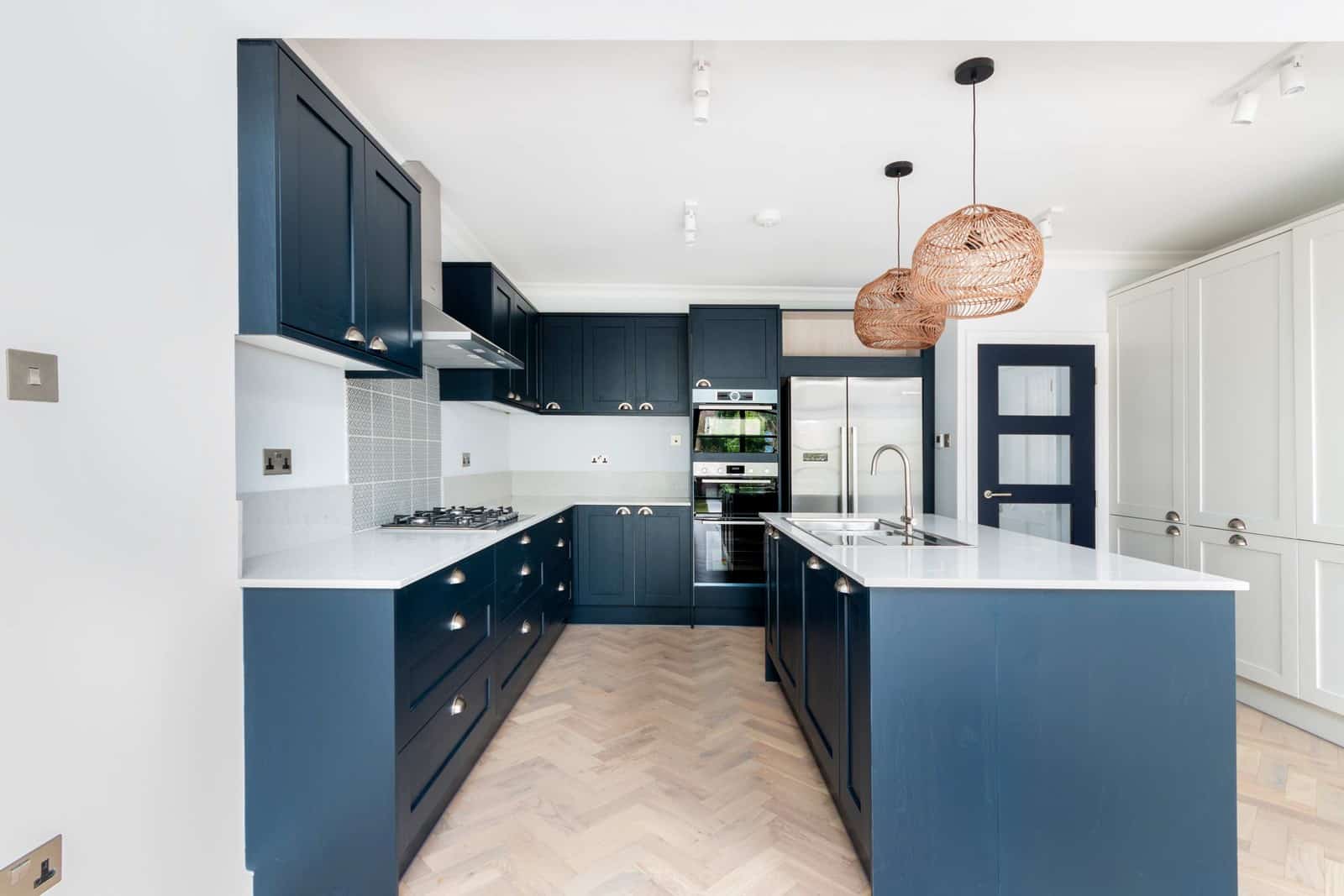
Daylight from glazing and rooflights
Daylight is predictable. In London, at about 51.5°N, the sun reaches 61.9° above the horizon at the June solstice and only 15.1° at the December solstice. High summer sun lands close to the glass; low winter sun reaches deep into the room.
| Date | Sun height at noon | Sunlight reaches into the room | What it means for the design |
|---|---|---|---|
| June solstice | 61.9° | About 1.3 m | Sun stays near the glazing; an overhang or deep reveal limits summer heat |
| December solstice | 15.1° | About 9 m | Low sun reaches the back of a deep plan, and glare needs thought |
That is why a south-facing glass wall can overheat in July and still be welcome in December. Rooflights work differently: they bring light from the brightest part of the sky into the middle of a deep plan, where side windows can’t reach. On the self-build family home we designed in Clapham, an electric opening rooflight with a rain sensor over the open-plan kitchen also ventilates the space in summer.
Worked example: how far the sun reaches
Take a south-facing opening with its head 2.4 m above the floor. The distance the sun reaches into the room at noon is the height of the opening divided by the tangent of the sun’s height.
| Date | Sun height | Tangent | Sum | Reach |
|---|---|---|---|---|
| June solstice | 61.9° | 1.873 | 2.4 ÷ 1.873 | 1.28 m, about 1.3 m |
| December solstice | 15.1° | 0.270 | 2.4 ÷ 0.270 | 8.9 m, about 9 m |
A 4 m deep extension gets summer sun only on the first 1.3 m of floor, while the December sun crosses the whole extension and carries on into the original house. A rooflight at the back of the extension, where the two parts meet, lights the area the glazing can’t reach in summer.
Exploring options
Test the ideas before you commit
The Concept Feasibility Package starts with a consultation and a study of the property, then up to three sketch schemes and a preliminary cost plan, so you can compare designs against your budget.
Materials for a modern extension
The materials on a modern extension are chosen against the house. On our projects they have ranged from brick matched to the terrace to cladding that contrasts with it, and the choice usually follows from the planning context.
| Material | Project | How it is used |
|---|---|---|
| Yellow stock brick with a zinc parapet | Wimbledon, double-fronted Victorian | A full-width 4 m extension in brick to match the house, with a contrasting parapet |
| Vertical blue tiles and dark metal framing | Dagmar Road, Camberwell | Tiles echo the outriggers along the terrace; the metal-framed infill stays subordinate |
| London stock brick and steel-framed doors | Marius Road, Balham | A side infill and rear extension designed to tidy a mismatched rear façade |
| Sedum roof with large rooflights | Maple Lodge, Hertfordshire | An extension of over 5 m with a wildflower sedum roof and rooflights over a covered seating area |
| Arched glazing with a rooflight in each arch | Toulmin Drive, Hertfordshire | Designed with arches of steel-framed style glazing, vaulted ceilings and a rooflight in each arch |
At Maple Lodge the clients’ main worry was light: they didn’t want the new extension to block light into the existing house. The brief included full-height glazing and a fully openable corner (Maple Lodge project). At Toulmin Drive, the arches were designed to let daylight into the new kitchen, with vaulted ceilings and a rooflight in each arch (Toulmin Drive project).
Energy in a modern home
A modern home should cost less to heat than the house did before. The Building Regulations drawings set U-values for each new element, and the builder builds to them. At Dagmar Road, the specification set a U-value target of 0.18 W/m²K for new walls and 0.13 W/m²K for the new ground floor and flat roof, with windows at 1.4 W/m²K.
| Element | Specified U-value (W/m²K) |
|---|---|
| New external walls | 0.18 |
| New ground floor | 0.13 |
| New flat roof | 0.13 |
| New windows | 1.4 |
These are design values, specified on the drawings, not measured results. Heat pumps and solar panels for a London house are covered in our guide to sustainable architecture.
Can you build a modern home in a conservation area?
Many London streets are in conservation areas, where the council looks at whether new work preserves or enhances the character of the area. A modern extension can meet that test when it is clearly subordinate to the house and its materials respond to the street. Whether your project needs planning permission at all is covered in our guide to planning permission vs permitted development.
Talk to a modern home architect
Tell us about your house and how you want to live in it. In a consultation we’ll look at the options for extending and opening up, and what planning is likely to allow.
FAQs
Can I add a modern extension to a house outside London?
Yes. Maple Lodge and Toulmin Drive are contemporary rear extensions we designed for houses in St Albans, Hertfordshire. The same design questions apply: how the extension sits against the house, where the light comes from and what the local planning policies allow.
Can I build a modern extension on a Victorian house?
Yes. Marius Road in Balham is a Victorian house with a side infill and rear extension designed to sit with it, and at Dagmar Road in Camberwell the extension picks up the rhythm of the outriggers along the terrace. The design has to respect the scale and rhythm of the house and terrace, and the planning drawings should show how it does.
Should I choose steel-framed glazing or large sliding doors?
They do different jobs. Steel-framed glazing has slim frames divided into a grid, which suits many period houses; large sliding panels give wider uninterrupted openings. The choice usually comes down to the look you want and the size of the opening.
Do I need planning permission for a modern rear extension?
Not always. Some single-storey rear extensions are permitted development, within limits on depth and height, and others need a full application. Conservation areas and flats have different rules, so check the route before the design is fixed.
What does “modern home” mean in AURA’s projects?
On our projects it means a house that has been opened up and extended for the way the family lives now, with more daylight and better insulation, designed around the existing house.
Do I need an architect to build a modern house?
No law requires one, but the title is protected: under section 20 of the Architects Act 1997, only people on the Architects Register can call themselves an architect in business. Whoever you appoint should be able to take the design through planning, Building Regulations and tender.
How do I find a modern home architect in London?
Start with built work: project pages that show finished houses like yours. Check the name on the Architects Register at arb.org.uk, and RIBA’s directory lists Chartered practices. Then meet the practices on your shortlist and ask how they would approach your house and what their fee covers.
Sources
- NOAA Solar Calculator: sun height at noon in London (51.5°N) at the June and December solstices
- AURA project pages for Dagmar Road, Wimbledon, Whitestile Road, Marius Road, Maple Lodge, Toulmin Drive and the Clapham new-build, read 3 November 2026
- AURA specification for Dagmar Road, Rev A, September 2021
Contents
Talk it through
Planning a modern home?
Book a consultation and talk it through with an architect.