
Design · Space saving
Six ways to find space in a London house before, or instead of, a big extension, with the Building Regulations limits that apply and two AURA projects that used them.
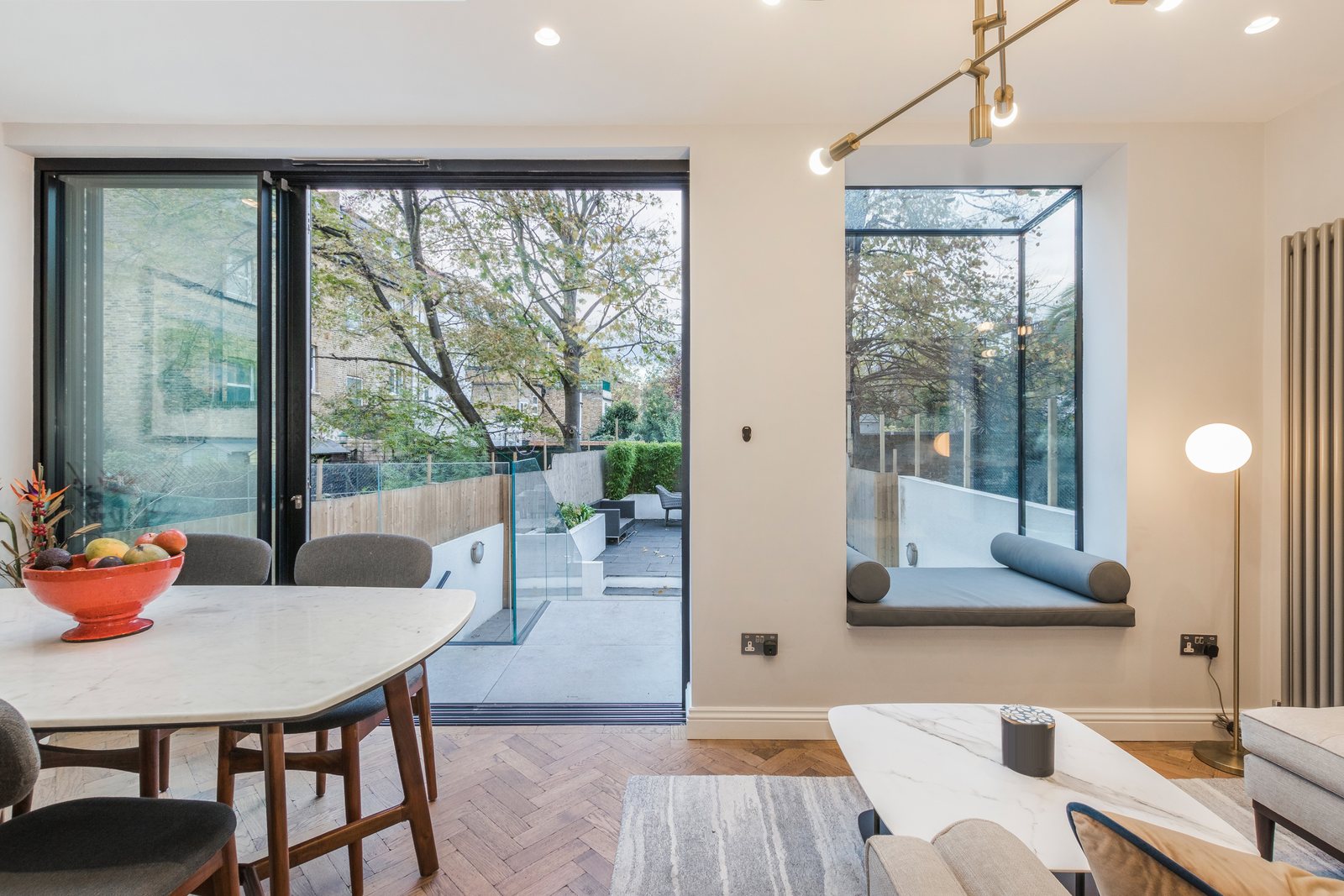
Space saving house design finds room in the house you already have: an infill or side return, rooms opened up or linked with sliding doors, joinery that can hide a WC, a window seat, a mezzanine in a tall room, or a lightwell. The rules still apply: a stair needs 2 m of headroom, and an escape window needs an opening of at least 0.33 m².
Key takeaways
- Work that affects only the inside of a house isn’t development under section 55 of the planning Act, so it doesn’t need planning permission; a listed building is different.
- Opening up rooms changes the escape routes: Approved Document B limits which rooms can be reached only through another room.
- A mezzanine or gallery needs an alternative exit, an escape window where its floor is no more than 4.5 m above ground, or the layout in Diagram 2.6 of Approved Document B.
- Built-in joinery and window seats add storage and seating without adding floor area.
Building Regulations figures come from Approved Document B, Volume 1 (2019 edition incorporating 2020, 2022, 2025 and 2026 amendments) and Approved Document K (2013 edition), for houses in England.
Contents
What is space saving house design?
Space saving architecture is the design of a house so every part of it is used: the narrow strip beside the back addition, the dark middle of the ground floor, the alcoves, the eaves and the height of a tall Victorian room. The six ideas below come from London houses and are listed with the rule or guide that goes with each.
| Idea | What it gains | What to check |
|---|---|---|
| 1. Infill or side return | Floor area beside the back addition | Planning or permitted development; party wall |
| 2. Opening up, or linking rooms with sliding doors | Light and flow through the ground floor | Structure; inner room rules (Approved Document B, paragraph 2.11) |
| 3. Built-in joinery, and a WC in the kitchen run | Storage and a WC without extra floor area | Ventilation and drainage for the WC |
| 4. Window seat | Seating and daylight in the same place | Planning where the window projects outside |
| 5. Mezzanine in a tall room | A study or sleeping platform | Escape from the gallery (paragraph 2.15); stair headroom of 2 m |
| 6. Lightwell | Daylight and air to a basement | New underground space is development (section 55); escape from basement rooms (paragraph 2.16) |
1. Infill and side return extensions
Where a terraced house has a back addition, the narrow side passage beside it can be filled with an infill or side return extension. The gain is less the area of the strip than what it does to the room beside it, which becomes wide enough for a kitchen and table together. At Dagmar Road in Camberwell, a lower ground and ground floor maisonette, AURA extended a cramped lower ground floor to the rear and designed an infill extension too, creating 4 bedrooms, 2 bathrooms and an open-plan kitchen and dining space.
Whether a side return or a wraparound suits your house is covered in our comparison of a side return vs wraparound extension, including the permitted development limits for each.
Your house
Short of space and not sure where to find it?
We can look at your house with you, see where space is going unused and set out the options before you commit to an extension.
2. Opening up, or broken plan with sliding doors
Taking out a wall can join two small rooms into one usable one, and sliding or glazed internal doors let you close them off again. At Brailsford Road in Brixton, a small dining room and utility space at the rear became one open-plan kitchen and dining area, and internal sliding doors with black frames zone the open-plan layout.
Opening up changes how people get out in a fire. Approved Document B, paragraph 2.11, allows an inner room (one reached only through another room) when it is a kitchen, a utility room, a dressing room, a bathroom or WC, a room on a storey no more than 4.5 m above ground with an emergency escape window, or a gallery that complies with paragraph 2.15. Removing a structural wall needs a beam, designed by a structural engineer and approved by building control.
3. Built-in joinery, and a WC in the kitchen run
Joinery built into alcoves, under the stair or in the eaves gives storage without taking floor space. At Brailsford Road the kitchen was entirely bespoke, including concealed joinery that hides a reconfigured ground-floor WC. In a loft, the low space under the eaves can become built-in cupboards; our guide to loft conversions in London covers how much height a loft room needs.
Brailsford Road, Brixton. An internal reconfiguration and full interior design of a period house: the ground floor opened up into one kitchen and dining area, internal sliding doors, a large rooflight over the kitchen, and a bespoke kitchen that conceals a ground-floor WC. See the Brailsford Road project.
For kitchen layouts that make room for joinery, our guide to kitchen extension ideas covers the layouts.
4. Window seats
A window seat puts seating and daylight in the same place. At Dagmar Road, AURA used an oriel window that projects out of the rear wall, giving a window seat, an extra sense of space and more daylight into the dining area (Dagmar Road project). A seat built into an existing bay or a deep window reveal needs no change to the outside of the house; an oriel projects outside the wall, so it is part of the planning design.
5. Mezzanines in tall rooms
A tall room, or an extension with a high ceiling, can take a mezzanine for a study or a sleeping platform. Approved Document B calls this a gallery, and paragraph 2.15 says it should have an alternative exit, or an emergency escape window where the gallery floor is no more than 4.5 m above ground, or meet the conditions in Diagram 2.6. The stair up to it needs at least 2 m of headroom (Approved Document K, paragraph 1.11).
A mezzanine floor also has to be designed for its load. Where a gallery relies on Diagram 2.6, any cooking facilities in the room are either enclosed in fire-resisting construction or kept away from the gallery stair.
6. Lightwells
A lightwell brings daylight and air to a basement room, and can give it an escape route. Approved Document B, paragraph 2.16, asks basement storeys with habitable rooms to have an emergency escape window or external door, or a protected stairway to a final exit. Unlike work to the interior of the house, digging out new space underground counts as development under section 55 of the planning Act, so a basement goes through the planning route. Our guide to basement conversions in London covers the costs and the planning, and our building cost guide compares the rates for each way of adding space.
How do the Building Regulations affect space-saving design?
Several of these ideas change how people move around the house, so the limits that apply are fire escape and stairs.
| Limit | Figure | Paragraph |
|---|---|---|
| Headroom over a stair | At least 2 m | ADK 1.11 |
| Headroom over a loft conversion stair, where 2 m isn’t possible | 1.9 m at the centre, 1.8 m at the side | ADK 1.13 |
| Emergency escape window: opening area | At least 0.33 m² | ADB 2.10 |
| Emergency escape window: opening size | At least 450 mm high and 450 mm wide | ADB 2.10 |
| Emergency escape window: height | Bottom of the opening no more than 1,100 mm above the floor | ADB 2.10 |
| Inner rooms | Only the kinds listed, such as a kitchen, utility room or WC | ADB 2.11 |
| Galleries and mezzanines | Alternative exit, escape window (floor no more than 4.5 m above ground) or Diagram 2.6 | ADB 2.15 |
Building control checks these on the drawings and on site.
Worked example: does the window work as an escape window?
A ground-floor room becomes an inner room when the wall to the hall comes out, so it relies on an emergency escape window. Three possible window openings, checked against paragraph 2.10 of Approved Document B. The window sizes are illustrative.
| Clear opening | Area sum | Width and height at least 450 mm? | Result |
|---|---|---|---|
| 450 × 700 mm | 0.45 × 0.70 = 0.315 m² | Yes | Fails: under 0.33 m² |
| 400 × 900 mm | 0.40 × 0.90 = 0.36 m² | No: 400 mm wide | Fails: too narrow |
| 450 × 750 mm | 0.45 × 0.75 = 0.3375 m² | Yes | Passes, if the bottom of the opening is no more than 1,100 mm above the floor |
The 400 mm wide window has the largest area but fails on width. The 450 × 750 mm opening passes on both, which is why the size of the openable part, not the overall window, is the figure to check on the drawings.
Does space-saving design need planning permission?
Not for work inside a house. Section 55(2)(a) of the Town and Country Planning Act 1990 says works that “affect only the interior of the building, or do not materially affect the external appearance of the building” aren’t development, except works begun after 5 December 1968 that provide additional space underground. An infill, a projecting window or a basement does change the outside, and a listed building needs listed building consent for internal works that affect its character. Our comparison of a basement vs loft vs extension sets out how the bigger options compare.
Talk to an architect about space
Tell us about your house and what isn’t working. In a consultation we’ll look at where space is going unused and what each option would involve.
FAQs
What is space saving architecture?
Designing a house so that every part is used: the side return, the middle of the ground floor, alcoves, eaves and tall rooms. It looks for space inside the house before adding floor area.
How can I make my house feel bigger without extending?
Open up or link rooms with sliding doors, build storage into alcoves and under the stair, and add a window seat or rooflight for daylight. Work that affects only the inside of a house doesn’t need planning permission, but a listed building is different.
Do I need building regulations for a mezzanine floor?
Yes. A mezzanine is a gallery under Approved Document B: it needs an alternative exit, an escape window where its floor is no more than 4.5 m above ground, or the conditions in Diagram 2.6, and the stair needs 2 m of headroom.
Can I knock through two rooms without planning permission?
Yes, because internal works aren’t development under section 55 of the planning Act; a listed building needs listed building consent instead. A structural wall needs a beam designed by an engineer and Building Regulations approval.
What size does an escape window need to be?
The openable part needs an area of at least 0.33 m², at least 450 mm high and 450 mm wide, with the bottom of the opening no more than 1,100 mm above the floor (Approved Document B, paragraph 2.10).
Is a side return extension worth it for space?
It turns a narrow side passage into part of the room beside it, which can then take a kitchen and a table together. Whether it suits your house depends on the planning route and the party wall; our side return guide compares it with a wraparound.
Can a window seat add space?
It adds seating and storage without adding floor area. An oriel window, as at Dagmar Road in Camberwell, projects out of the wall, so it is part of the planning design; a seat in an existing bay doesn’t change the outside.
Sources
- Approved Document B, Volume 1: Dwellings, 2019 edition incorporating 2020, 2022, 2025 and 2026 amendments, paragraphs 2.10, 2.11, 2.15, 2.16 and Diagram 2.6: gov.uk
- Approved Document K, 2013 edition, paragraphs 1.11 and 1.13: gov.uk
- Town and Country Planning Act 1990, section 55: legislation.gov.uk, read 10 November 2026
- AURA project pages for Dagmar Road and Brailsford Road, read 10 November 2026
Contents
Talk it through
Short of space at home?
Book a consultation and talk it through with an architect.