
House extensions · Interior design
How to plan a London kitchen extension around layout and daylight, with four AURA projects and the design and build times we recorded.
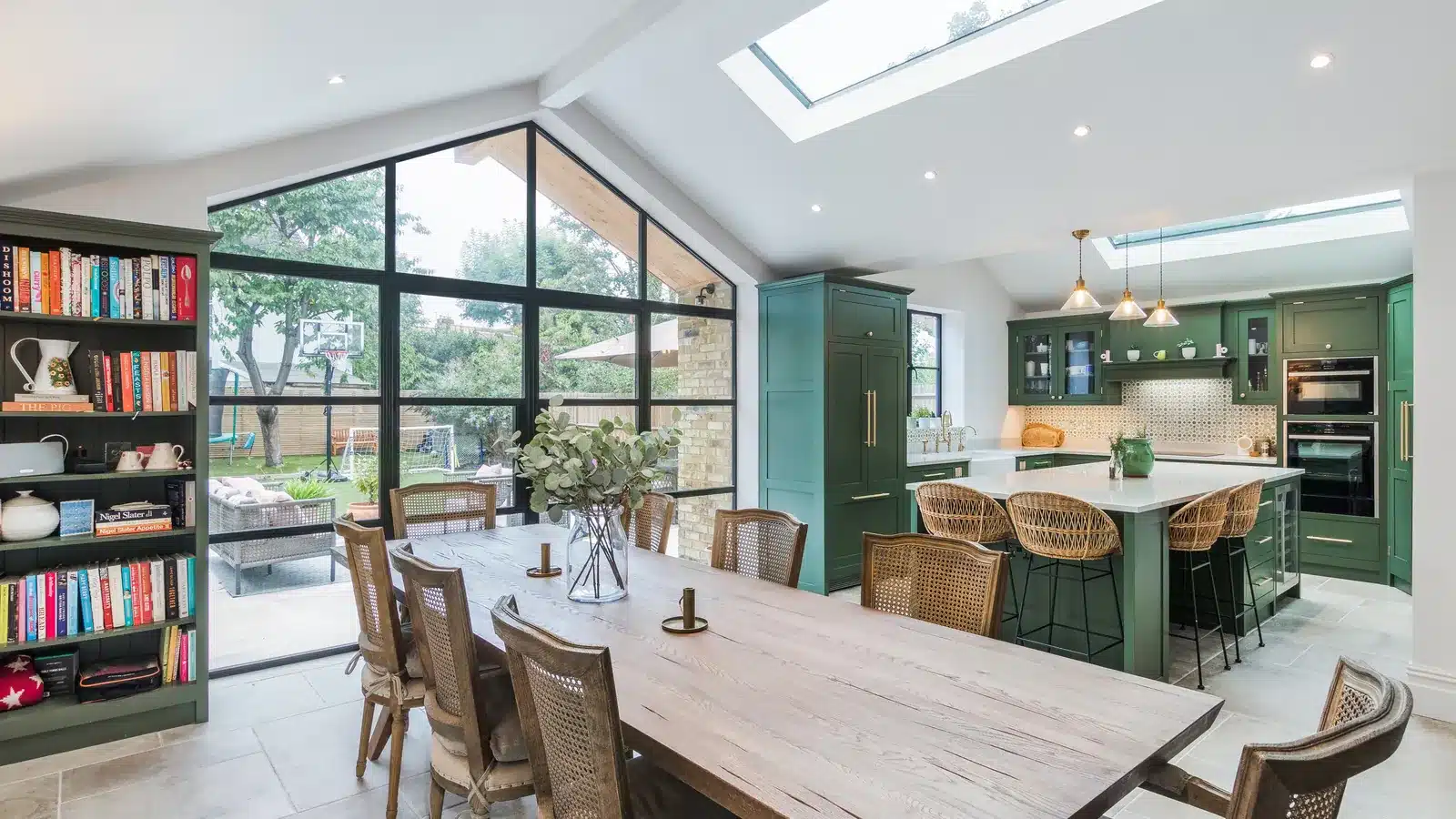
The best kitchen extension ideas for a London house start with the plan you already have: where the garden is, where the light comes from, and which room sits dark in the middle. Most terraces suit one of four layouts: a rear extension, a side return infill, a wraparound, or a remodel with a small extension. Get the layout and the daylight right first, and the kitchen design follows.
Key takeaways
- Choose the layout by what’s wrong with the house now: a dark middle room, a small garden, or space in the wrong place.
- Light the middle of a deep plan from above. Garden doors alone only reach so far, and in June the sun comes about 1.3m through a 2.4m-high south opening.
- Fix the kitchen layout before the builder prices the job, so the services are drawn once.
- On two of our projects, design took 4 to 5 months and the build 6 months (one of those builds covered the whole house).
The figures here are approximate and meant to give you an idea, not a quote. Every house and brief is different, so your costs and programme will depend on your project.
Contents
| Layout | What it changes | The light challenge | Best when | AURA example |
|---|---|---|---|---|
| Rear extension | Adds depth across the back of the house, usually opening the old back room into the new one | The new room is bright by the garden and darker where it meets the old house | The garden is deep enough to give up some length | Cromwell Road, Wimbledon SW19; Whitestile Road, Brentford TW8 |
| Side return (infill) | Fills the narrow strip beside the back addition, widening a galley kitchen into a proper room | Light has to come from above, because the side wall faces the neighbour | The garden is small and the middle room is dark | Dagmar Road, Camberwell SE5 (rear extension plus a glazed infill, in a maisonette) |
| Wraparound (L-shape) | Combines a rear and a side infill into one large room | The deepest corner sits far from any window | You want one big room and the plan can light the back of it | None shown here |
| Remodel plus small extension | Rearranges the rooms you have, adding only the floor area the plan is missing | Borrowing light from the extension into rooms that stay put | The house has the space but the wrong layout | Thrale Road, Streatham SW16 |
Your house
Not sure which layout suits your house?
We can look at your plans, your garden and where the light comes from, and tell you which layout makes sense before you spend on drawings.
Kitchen extension ideas: which layout suits a London house?
It depends on the house you already have, mostly where the light and the garden are. Most London terraces extend in one of four ways: straight out at the back, into the side return, both at once as a wraparound, or a reshuffle of the existing rooms with a small extension. A maisonette adds a fifth question: which floor.
A rear extension pushes the back of the house into the garden. It’s the simplest shape to build and to light at the garden end, and it usually means knocking through to the existing back room so the kitchen, dining and sitting areas become one space. The trade-off is garden length, which matters more on a short London plot.
A side return infill uses the strip of yard beside the back addition, which on many Victorian terraces is dark and barely used. A wraparound joins that infill to a rear extension in an L-shape for the largest single room. Both have to bring light in from above, and both come with tighter rules than a simple rear extension. We set out how a side return compares with a wraparound in a separate guide.
Sometimes the house doesn’t need much more floor area at all. The rooms are there, but the kitchen is in the wrong one, or the dining table is stranded in a corridor of a room. A remodel with a small extension rearranges what’s already paid for and adds only the missing piece.
In a lower-ground and ground-floor maisonette, the first decision is where the kitchen lives. The lower ground is the floor nearest the garden, but it starts out darker, sometimes with steps up to the lawn, so the extension has to work harder for light.
How should an open plan kitchen extension be laid out?
Lay it out as zones: cooking, cleaning, eating and sitting, each with its own light and its own reason to be there. Keep the sink, hob and fridge in a tight triangle, put the sink where the view is, and give the dining table real daylight instead of the middle of the room.
The “kitchen triangle” is the old rule that the sink, hob and fridge should sit within a few easy steps of each other, with nothing cutting across the route. It still holds in an open plan room. An island changes it: put the hob or sink on the island and the triangle gets shorter, but the island also becomes the place everyone stands, so keep the main walkway to the garden doors clear of the cooking side.
Put the sink where you’ll want to look up. On our Thrale Road project in Streatham, a window above the sink gives a view straight out into the garden, which is where the person washing up spends most of their time looking.
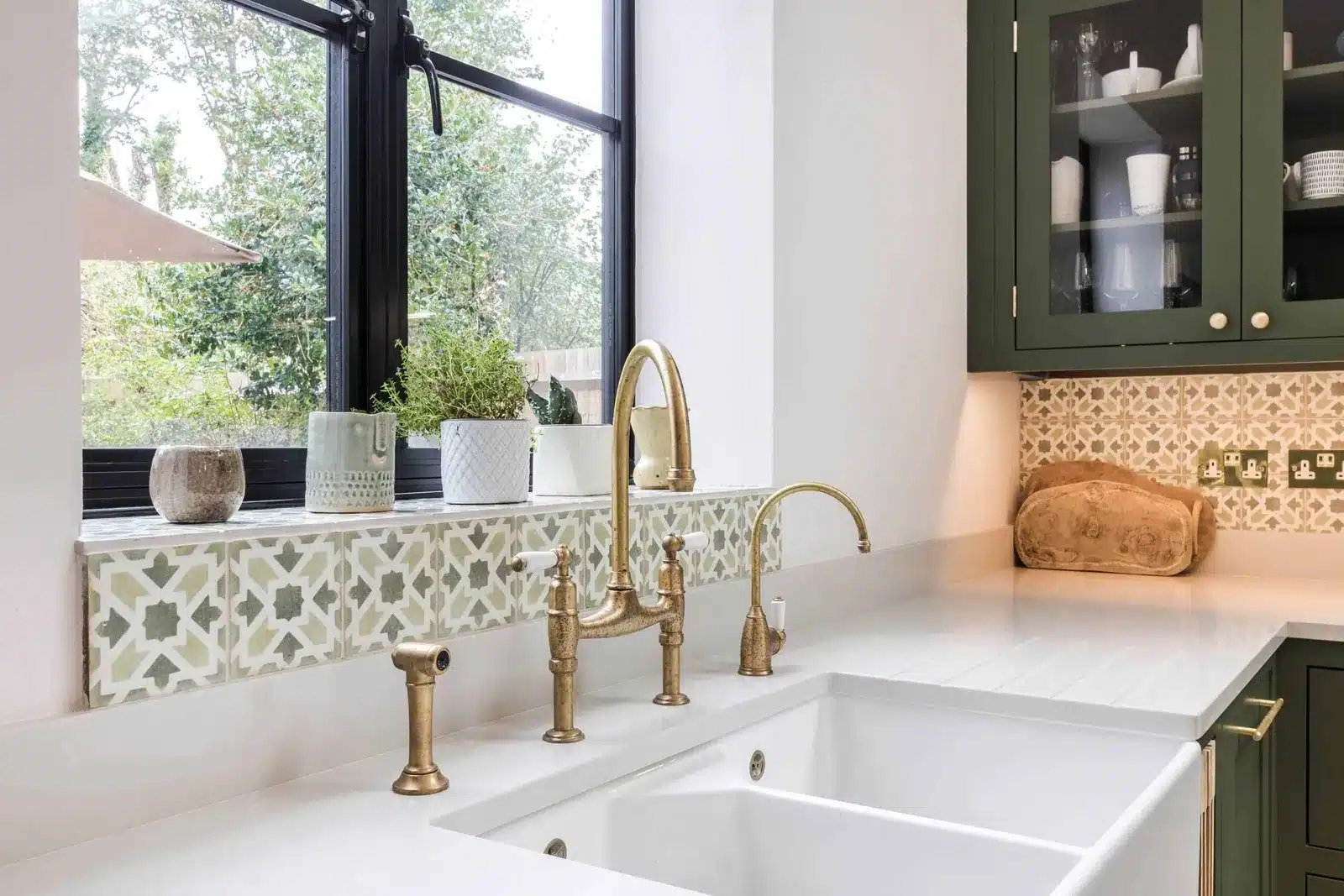
The dining table needs light of its own. In many terraces the table ends up in the middle room, between the kitchen and the reception room, with the least daylight in the house. In an extension, give it a place by the glazing, under a rooflight or beside a window seat, so it’s a spot people choose to sit.
An open plan room still needs corners. A snug or break-out area off the kitchen, with a sofa or a desk, lets one person read while another cooks, and it stops the room feeling like a large hall. The room doesn’t have to be a plain rectangle to work.
Bring your kitchen designer in early and let them work with your architect. A kitchen company can show 3D views and knows how its units fit together, while the architect makes sure the plan, the structure and the services suit the layout. Two or three options, tested together, beat one drawn in isolation.
How do you get daylight into the middle of the house?
Bring light down from above where the new room meets the old house, and let the garden glazing light the end nearest the garden. In a terrace the middle room is the dark one, so well-placed rooflights, a glazed infill or a projecting window seat often do more than wider doors.
A terrace is narrow and deep. Every metre you add at the back pushes the old middle room further from the garden, and that room was usually the darkest in the house to begin with. A big run of glazing at the end of the extension lights the end of the extension. The rest of the plan needs light from somewhere else.
The sun angles explain why. In London the midday sun is 61.9° above the horizon at the June solstice and 15.1° at the December solstice. Through a 2.4m-high south-facing opening, that’s direct sun reaching about 1.3m into the room in June and about 9m in December. So south-facing doors bring low winter sun deep into the house, but in summer the sun stays near the glass, and rooflights are what put daylight into the middle.
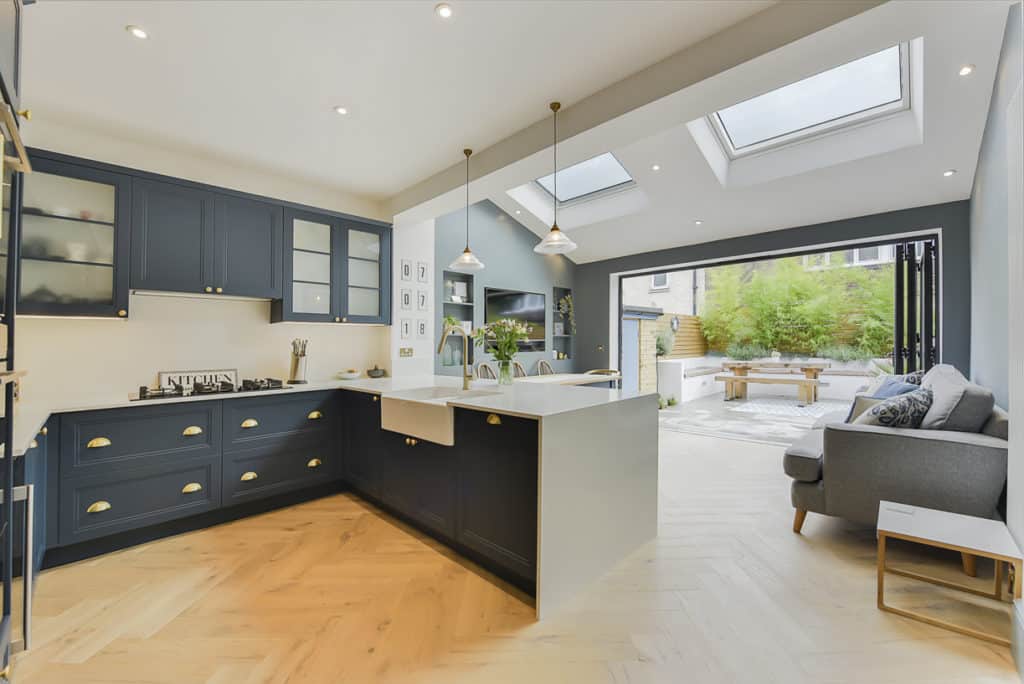
Place rooflights for what’s under them. One over the worktop gives task light where you need it, and one close to the old house reaches the part of the plan the garden glazing can’t. On our Cromwell Road project in Wimbledon, three large rooflights were added to the 4m deep extension to let light reach deeper into the kitchen, dining and living space.
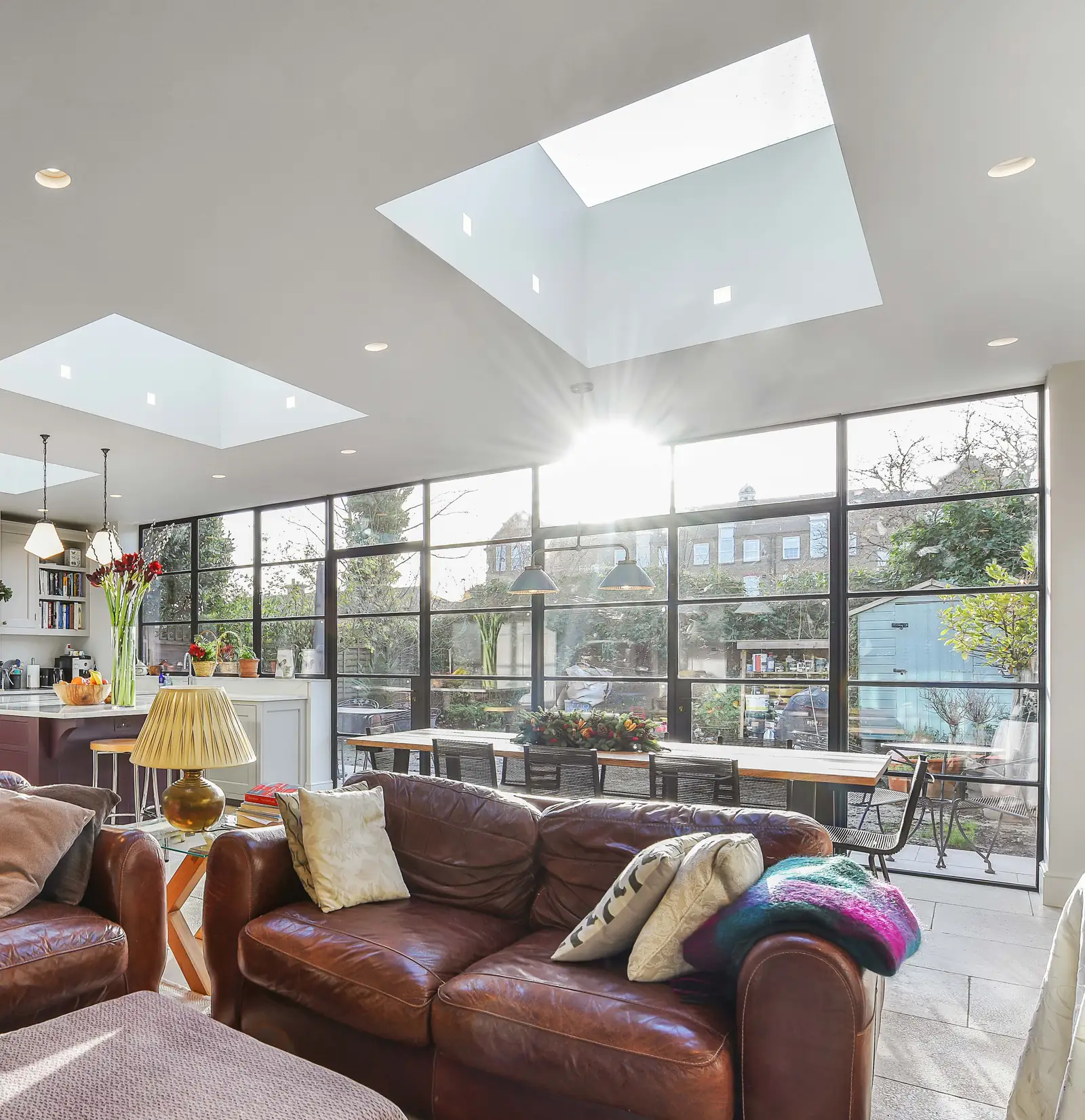
Light can be borrowed, too. A glazed infill lets daylight down the side of the house into rooms that stay where they are, and a window that projects out of the wall, such as an oriel with a seat, catches light from more than one direction. Vaulted ceilings add height that a flat roof can’t, and the extra wall height can carry high windows.
Orientation changes the brief. A north-facing garden gives steady, even light with little glare, so rooflights carry more of the load. A south-facing garden gives plenty of light and plenty of heat, which is covered under what can go wrong, below.
There’s also an official limit on glazing. Currently, under Approved Document L, the windows, rooflights and doors in an extension shouldn’t exceed 25% of its floor area, plus the area of any windows and doors the extension covers up. More glass is possible, but it’s traded against better insulation elsewhere, using the alternative calculation routes the guidance allows. The 2026 edition, which takes effect on 24 March 2027, keeps the same rule.
Four London kitchen extensions, and the decision behind each
Four AURA projects show the range: a cramped Victorian plan in Streatham, a period house in Brentford, a dark lower-ground maisonette in Camberwell and a double-fronted Victorian in Wimbledon. Each one turned on a single decision about layout or light, and two have recorded design and build times.
Each house below had a different problem, so each layout answers something different.
Thrale Road, Streatham SW16: the dining table caught in the middle
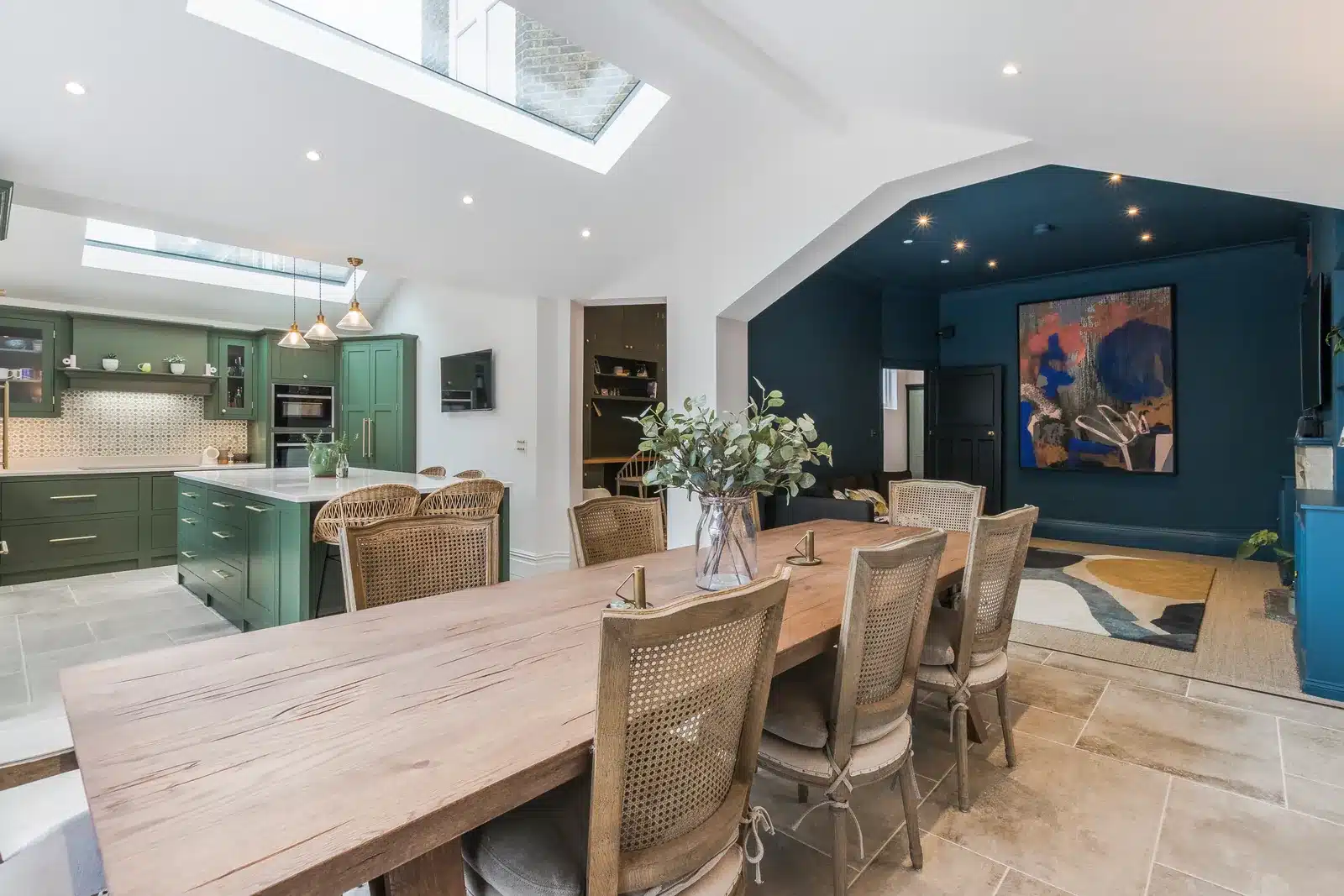
The problem. The house already had a small single-storey extension, but the dining table was caught in the middle of the property, with one small window letting light in. The Victorian ceilings were over 2.8m high and the space still felt cramped.
The decision. The small extension was enlarged into an open plan kitchen, dining and living space, with glazing out to the garden. A single-storey side extension opened up the old store area to make a utility room.
What changed. Undulating vaulted roofs mark the step from the existing house into the new extension, so the move from old to new reads as a change of ceiling. The build date was 2022.
Whitestile Road, Brentford TW8: one connection from kitchen to patio
The problem. The brief was a clean, modern extension that still fitted the period house, with plenty of light and a big kitchen.
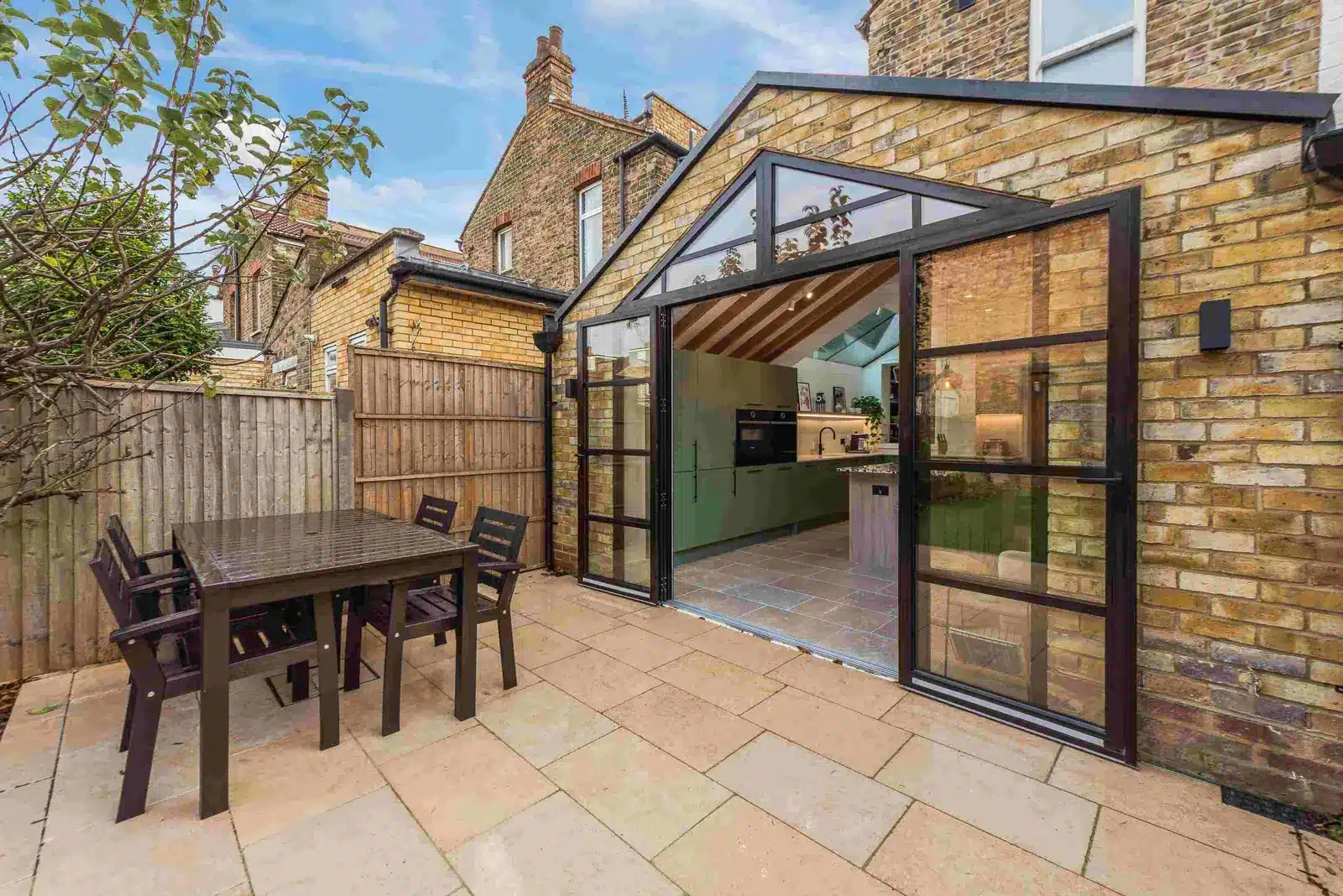
The decision. Bi-fold doors and rooflights bring the light in, and the new patio was designed as part of the connection with the inside, so the kitchen and the garden were drawn together. A downstairs WC and utility room were added.
What changed. The kitchen has shaker-style cabinets, a granite worktop and an induction hob. Design took 4 months and the build 6 months, from April to September 2021.
Dagmar Road, Camberwell SE5: a dark lower ground, and a window seat
The problem. This lower-ground and ground-floor maisonette had a cramped, dark lower ground floor with a very small kitchen and steps up into the garden.
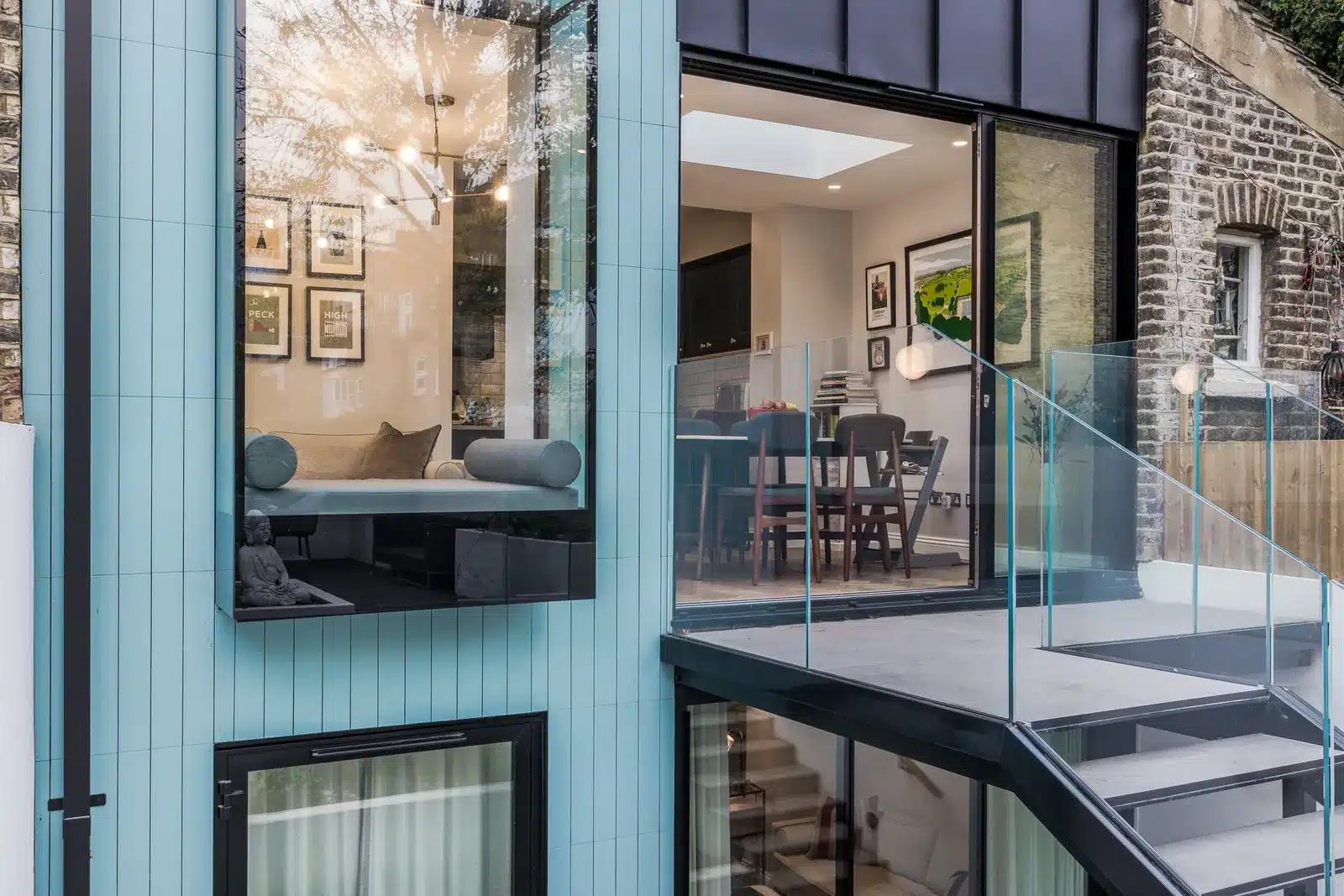
The decision. The house was extended to the rear, with an infill extension as well, as part of a full renovation to 4 bedrooms and 2 bathrooms with an open plan kitchen and dining room. Large windows and rooflights bring the light in, and an oriel window projects out of the rear wall to make a window seat and send more light into the dining area.
What changed. The vertical blue tiles repeat the rhythm of the rear outriggers along the terrace, and the dark metal-framed glazed infill stays subordinate to the main house. The build date was 2022.
Cromwell Road, Wimbledon SW19: 4m deep, and light pushed further in
The problem. A double-fronted Victorian house that was dark and tired, and no longer worked for a growing family.
The decision. A 4m deep single-storey extension runs the full width of the house, in yellow stock brick with a contrasting zinc parapet. Large Crittall-style windows and doors open to the south-facing garden.
What changed. The shaker kitchen centres on an island, with a pantry and a utility room tucked out of sight. Large-format limestone tiles with underfloor heating help reflect the light. Design took 5 months and the build 6 months, from April to October 2018, alongside a remodel and refurbishment of the whole house.
When we’d recommend each layout
We’d choose by what’s wrong with the house. A rear extension when the garden is deep and the kitchen sits in the side return. A side infill when the garden is small and the middle room is dark. A wraparound for one big room, if the back can be lit. A remodel when the space exists but works badly.
Rear extension. We’d recommend it when the garden has length to spare and the existing kitchen already runs along the side of the house. Extending at the back turns that galley into the working side of a larger room, with the table and sofa nearer the garden.
Side infill. We’d recommend it when the garden is short and every metre of it counts. Filling the side strip gains a wide room without losing garden length, and it solves the dark middle room at the same time, as long as the roof is designed for light.
Wraparound. We’d recommend it when you want one large room for cooking, eating and sitting, and the plan can get daylight into the far corner. Without that, the biggest room in the house can also be the dimmest in places.
Remodel plus a small extension. We’d recommend it when the house already has enough floor area but the rooms are in the wrong order, as at Thrale Road. It often costs less than a big extension, because less is built new, and the old rooms get a purpose again.
Maisonettes. In a lower-ground and ground-floor maisonette, we’d usually look first at the lower ground for the kitchen, as at Dagmar Road. That floor starts dark, and at Dagmar Road it also had steps up into the garden, so the rear extension, the glazed infill and the rooflights were all designed to bring light in.
Two habits help whichever layout you choose. Look at what your neighbours have already built, because an extension that follows a pattern on your street is more likely to get through planning. And bring a few precedent images, from Pinterest or a magazine, so the architect designing your extension can read your taste before the first sketch.
First step
Get options for your own house
Our fixed-fee Concept Feasibility Package sets out what your house could take, the likely planning route and a cost conversation, before you commit to a full design.
What to settle early: budget and permission
Settle two things before the design goes far: a budget that covers both the building and the kitchen inside it, and the planning route your layout needs. Both can change the shape of the scheme, so it’s far easier to know them at sketch stage than after the drawings are done.
Our guide rate for a single-storey extension is approx. £3,000 to £3,500 per m² of new floor area, with VAT added on top at 20%, and small side returns often cost more per m². The kitchen itself is priced separately: approx. £6,000+, £15,000+ or £40,000+ for about 20 units with appliances, from basic to high spec. Our guide to house extension costs breaks these figures down.
Many single-storey rear kitchen extensions can go ahead under permitted development, or under prior approval if they go deeper. Side and wraparound layouts carry extra limits, because the official guidance judges an infill as both a side and a rear extension, with a half-width rule.
Planning the build around the kitchen
Settle the kitchen at design stage, so the technical drawings and the builders’ prices already include it. On our Whitestile Road kitchen extension in Brentford, design took 4 months and the build 6 months. On Cromwell Road in Wimbledon it was 5 months and 6 months, but that build covered the whole house.
| Project | Design | Build | What the build included |
|---|---|---|---|
| Whitestile Road, Brentford TW8 | 4 months | 6 months (April to September 2021) | Kitchen extension with bi-fold doors, rooflights, a new patio and a downstairs WC/utility |
| Cromwell Road, Wimbledon SW19 | 5 months | 6 months (April to October 2018) | 4m deep full-width extension, plus a remodel and refurbishment of the whole house |
The work runs in five stages: survey and design, approvals, technical drawings, tender, and the build. You can follow every stage of a renovation on one finished house. The kitchen doesn’t need a stage of its own: its layout is settled in design, and it’s fitted during the build. How long planning permission takes depends on the route your layout takes, and it’s worth knowing before you set a start date.
What can go wrong with a kitchen extension, and how to avoid it
Most problems start as late decisions: a kitchen designed after the builder has priced the job, extraction planned at the end, a steel beam no one showed on the ceiling. Others come from the site, like a drain under the footprint. Settle them at drawing stage, while they’re still easy to change.
The kitchen is designed after the job is priced
Electrics, plumbing, drainage and extraction all follow the kitchen layout. If the kitchen arrives after the builder has priced the drawings, sockets, pipes and ducts move, and each move is a change to the contract. Agree the layout with your kitchen designer before tender.
A steel beam breaks the ceiling line
When the back wall comes out, a steel beam usually carries the house above. If it hangs below the ceiling, it draws a line across the room exactly where old meets new. Decide early whether it sits up within the floor or stays visible as a deliberate step, because that choice shapes the structural design.
Extraction is added late
An open plan kitchen needs proper extraction. The official minimum under Approved Document F is 30 litres per second for a cooker hood that extracts outside, or 60 litres per second where there’s no hood or the hood doesn’t extract outside. The duct has to reach an outside wall or the roof, so its route belongs on the drawings, especially with a hob on an island.
Too much south-facing glass
A south-facing extension with large doors and rooflights can get hot and glary in summer. Approved Document O, the overheating guidance, applies to new homes only, so on an extension the answer is design: rooflights that open, shading over the south glass, and glass chosen for the orientation. Because the summer sun is high, a modest overhang shades south doors in June and still lets the low winter sun in.
A drain under the footprint
Many London terraces have a drain or manhole at the back of the house. Find it with a survey before the footprint is fixed, because building over or near a public sewer usually needs the water company’s agreement. The FAQ below explains how that works.
A boundary wall that feels overbearing
A tall flat wall on the boundary can feel overbearing from next door, and planners look out for it. Keep the boundary wall low, close to the height of the existing party wall or the neighbour’s extension, and slope the roof up and away from it. Rooflights in that slope land right above the worktop.
The old house loses its character
Cornices, tall ceilings, sash windows and the rhythm of the terrace’s back walls are part of what makes the house worth extending. Keep the period rooms as period rooms, and make the junction with the new part clear, with a change in ceiling or a slim glazed link, so each part reads as itself.
FAQs
How big does a kitchen need to be for an island?
There’s no official minimum, so it comes down to movement. You need room to walk round all sides with the dishwasher, oven and fridge doors open, and for two people to pass while one cooks. If the room can’t give that clearance on both sides, a peninsula, joined to the run of units at one end, gives the same worktop and seating with one walkway instead of two.
What size is a 3 metre kitchen extension in practice?
On its own, 3m of extra depth across a terrace is modest. It works because it joins the existing back room: knock through and the 3m becomes part of a much deeper space. The kitchen can stay in the old room while the new 3m takes the table or a sitting area by the garden. Whether an island fits as well depends on the width of the house.
Are bi-fold or sliding doors better for a kitchen extension?
Bi-folds open almost the full width, so the kitchen and garden join in summer, but when they’re closed the folded frames sit in a stack and there are more frames in the view. Sliding doors open less of the width, because one panel stays fixed, but have fewer, larger panes, so the view is cleaner for the rest of the year. Whitestile Road chose bi-folds to tie the kitchen to its patio.
How many rooflights does a kitchen extension need?
There’s no fixed number. Place them where the garden glazing can’t reach: near the old house in a deep plan, over the worktop for task light, and over a side infill where the wall faces the neighbour. Each one counts towards the glazing limit, so a few well-placed rooflights usually do more than many small ones. The depth of the plan decides how many.
What happens to the old kitchen and dining room once the extension opens up?
They usually get a new job. At Thrale Road the old dining space became a study nook and the reception room became a TV and games room for the children. At Cromwell Road large pocket sliding doors let the front reception room close off from the open plan space, so the house keeps one quiet room.
What happens if a drain runs under my new kitchen?
If Thames Water is your sewer provider, you usually need a build-over agreement to build within 3 metres of a public sewer or within 1 metre of a public lateral drain. You apply online through Thames Water’s build over application checklist, or use its “Tell us your plans” service if you’re unsure. Plan it early, because a pipe under the footprint can change the foundations.
Talk to an architect about your house
Tell us about your house and how you want the kitchen to work. We’ll start from the plan you already have and tell you honestly which layout suits it.
Sources
- gov.uk, Permitted development rights for householders: technical guidance (September 2019), pages 16 to 23: https://www.gov.uk/government/publications/permitted-development-rights-for-householders-technical-guidance
- gov.uk, Approved Document L, Volume 1: Dwellings, 2021 edition incorporating 2023 amendments, para 10.7(d); 2026 edition takes effect 24 March 2027: https://www.gov.uk/government/publications/conservation-of-fuel-and-power-approved-document-l
- gov.uk, Approved Document F, Volume 1: Dwellings, 2021 edition, Table 1.1: https://www.gov.uk/government/publications/ventilation-approved-document-f
- gov.uk, Approved Document O (2021), para 0.3: https://www.gov.uk/government/publications/overheating-approved-document-o
- Thames Water, Do I need a build over agreement?: https://www.thameswater.co.uk/help/home-improvements/do-i-need-a-build-agreement
- Sun altitude for London (51.5°N), NOAA Solar Calculator, recomputed: 61.9° June solstice, 15.1° December solstice; penetration through a 2.4m opening by height ÷ tan(altitude)
- AURA, house extension cost guide (single-storey rate and kitchen fit-out)
- AURA project pages: Thrale Road (Streatham), Whitestile Road (Brentford), Dagmar Road (Camberwell), Cromwell Road (Wimbledon)
Contents
Talk it through
Planning a kitchen extension?
Book a consultation and talk it through with an architect.
Want your dream Kitchen Extension?
Looking to create an amazing family entertaining space?
The kitchen is the heart of a home and usually where we spend the most time living! Why not improve the quality of your time spent at home by improving the space in which you live. Nearly every home can benefit from a ground floor kitchen extension. Creating space and improving the design and the flow of your kitchen and living spaces is the perfect way to improve your home.
To have a large kitchen island, you need a big open space. Before islands were a trend, kitchens were often designed to be a lot narrower. It's no wonder everyone is transforming traditional London homes by knocking through walls and extending in all directions! Whether your kitchen extension is across the back of your house or down the side in wasted space, with the right architect you can create a wow factor at the heart of your home.
Take a look at two of the stunning kitchen extensions we have designed for other London homeowners below.....

TYPES OF EXTENSIONS
There are different types of ground floor kitchen extensions you can choose from, depending on what your home has to offer.
Have you got plenty of garden space? Is your garden space precious but you have a wasted side return? Do you have so much space out the rear that you don’t even know what to do with it all?!?
Here are the 3 most common forms of ground floor extension.....


How much will it cost?
Construction Costs
When looking to do an extension of your kitchen, costs vary depending on the project and the quality of finishes and fixtures you choose. It can vary anywhere between £1000 and £2000 per square meter. For a better guide, read our blog post how much your kitchen extension will cost.
Architects Fees
Unlike a lot of architects, we charge a fixed fee. How do we come up with this fee? We take a look at your project and we estimate the amount of hours that will be needed for each stage and multiply this by our hourly rate of £75+VAT/hour. We break our fees into sections so you can pick and choose what services you want from us. From planning applications right through to site management, with add-ons such as a 3D model or our interior design service. Its up to you! To read more about our fees and to see our average hourly estimate take a look at our fees page here.
How to Add Value
How can you add value to your home by adding a kitchen extension?
Here’s a few tips from us..
Start designing your ideal home by Clicking Here